Actions
How is EES transforming Europe’s border management? Philippe Harant, Head of Strategy, Capabilities and Coordination Unit at eu-LISA, explores the topic in the September 2026 issue of Border Management Today.

Europe’s borders are undergoing the most significant transformation in decades as border management becomes increasingly digital, data driven and interconnected, a shift that redefines how millions travel, how authorities operate, and how security is ensured.
Established in 2012, eu-LISA is the EU Agency responsible for operating the large scale IT systems that support Justice and Home Affairs, supporting both the European Commission and Member States through technology. The Agency manages the Schengen Information System (SIS), the Visa Information System (VIS), Eurodac, the Entry/Exit System (EES), and e-CODEX. To give an idea of the magnitude of these systems: SIS alone contains 94 million alerts and was queried 17 billion times in 2025, around two million checks every hour.
Border management must balance two competing expectations:
- enhance the security of the Schengen area, to combat cross-border crime, terrorism and illegal migration.
- facilitate travel, as tourism is a major contributor to the EU economy (about 10% of EU GDP), with Europe being the world’s leading travel destination, attracting 40% of global tourism and more than 380 million travellers each year.
Technology is a key enabler to reconcile these two objectives.
2025 and 2026 have been important years for border management in Europe and for the Agency, with major milestones achieved in a short period of time. In less than two years, Europe is gradually moving from fragmented legacy systems to a modern, biometric-enabled, interoperable border architecture:
- In May 2025, eu-LISA launched the shared Biometric Matching Service (sBMS), the first building block of the EU interoperability architecture. Designed to support multiple systems, the sBMS enables fingerprint and facial recognition matching to improve the accuracy of identity verification, further strengthening the security of the Schengen zone. In summer 2025, the Commission’s Joint Research Centre (JRC) conducted an independent evaluation of the service, using real data from the VIS, confirming its high level of performance and accuracy and providing reassurance on its reliability.
- In October 2025, after a long wait and several delays, the Entry/Exit System (EES) entered into operation with a six-month progressive rollout. Although the central system was fully operational from day one, Member States were allowed to connect gradually. By 10 April 2026, EES was successfully deployed at more than 1,800 external Schengen border crossing points. One of the most complex IT systems ever deployed in the public sector, EES relies on a central system hosted by eu-LISA, connected to the different national systems. The central system is now fully operational and delivering a stable and reliable performance, with eu-LISA providing 24/7 support to the Commission and Member States. EES is used daily by border guards, visa, law enforcement and migration authorities, as well as carriers. Over 85% of carriers worldwide are already onboarded, with 350 actively transmitting data. The system contributes to the prevention of illegal migration, the identification of overstayers and the detection of attempts to cross the border using forged or fraudulent documents. It enables full automation, through self-service kiosks for travellers, handheld devices used by border guards and law enforcement, and Frontex mobile application for preregistration.
- Another important milestone was reached on 12 June 2026, with the entry into operation of Eurodac, the central system supporting the EU Pact on Migration and Asylum. The new Eurodac completely transforms the legacy database into a comprehensive asylum and migration system, no longer limited to fingerprints, but also incorporating facial image and biographic data. This makes it a case management tool to support Member States, streamline the asylum process and better monitor illegal border crossing. Eurodac was implemented in just two years after the adoption of the Pact, a remarkably short time-to-market for such a complex system. It was accompanied by the introduction of several new interoperability components.
Although still at a very early stage, the first statistics already highlight the added value of the system for border operation and policy making. eu-LISA published the first quarterly reports, and while the progressive rollout makes it premature to draw firm conclusions, the initial figures are significant. From October 2025 until the end of March 2026, 28,165 entries were refused for reasons such as the lack of valid visa or residence permit, exceeding the permitted three months stay, or not meeting the purpose for entry. Among these refusals, the EES triggered 3748 alerts in SIS, and 737 individuals were denied entry to the Schengen area due to public security or public health threat concerns.
Architecture and interoperability components
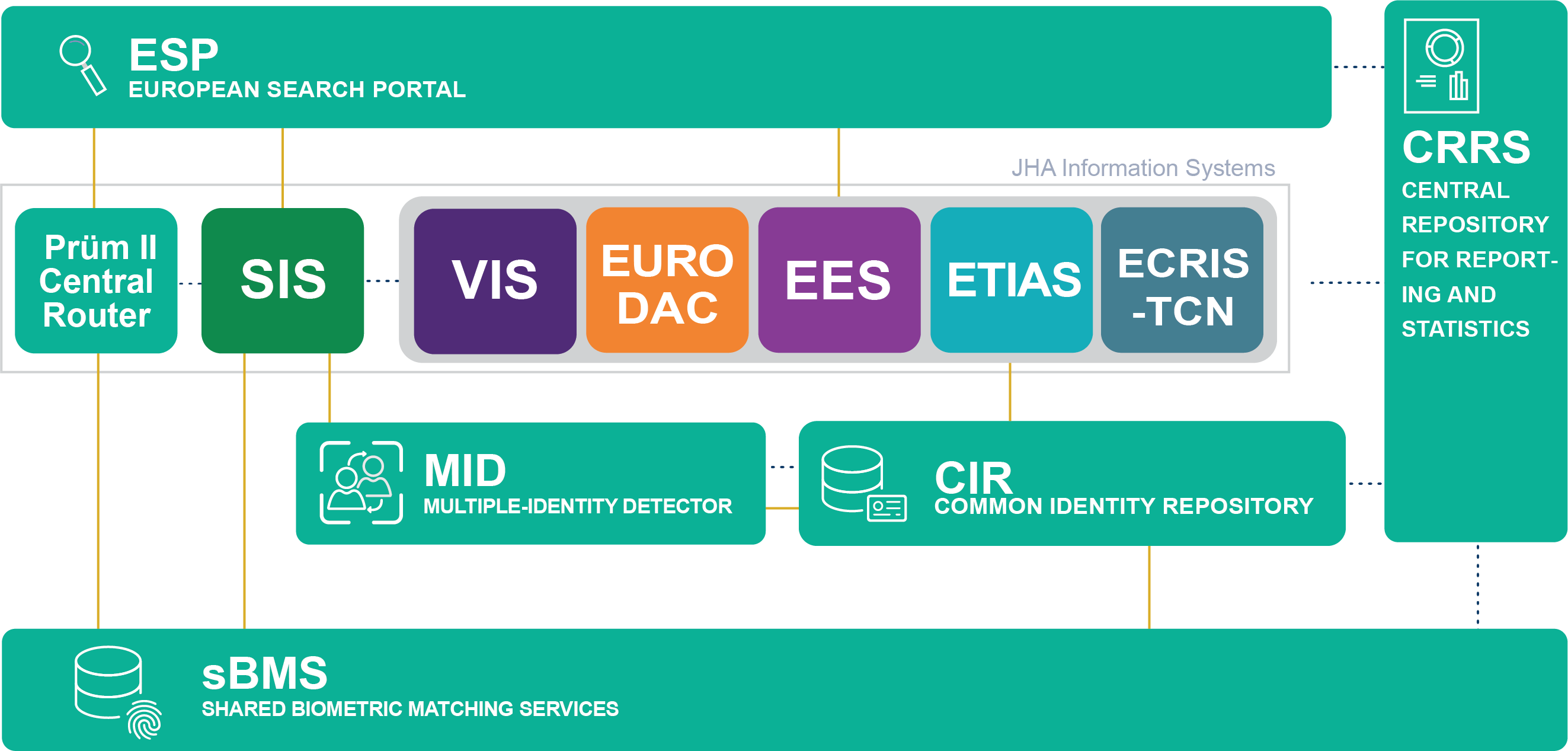
Interoperability (see fig. 1) refers to the ability of EU large scale IT systems to work together. Until now, systems such as SIS, VIS and Eurodac operated in silos, with no exchange of information. Interoperability creates bridges between them, enabling data to be shared and accessed more efficiently. It introduces new tools and services, including the European Search Portal, a single entry-point to all systems, and the Common Identity Repository (CIR). In the coming months, the next version of Eurodac will add the Central Repository for Reporting and Statistics (CRRS) that will collect statistical data from the different systems. Finally, in 2027 the Multiple Identity Detector (MID) will be introduced to compare data across different systems and identify cases where a person may be linked to multiple identities.
Why was the successful entry into operation of Eurodac so important?
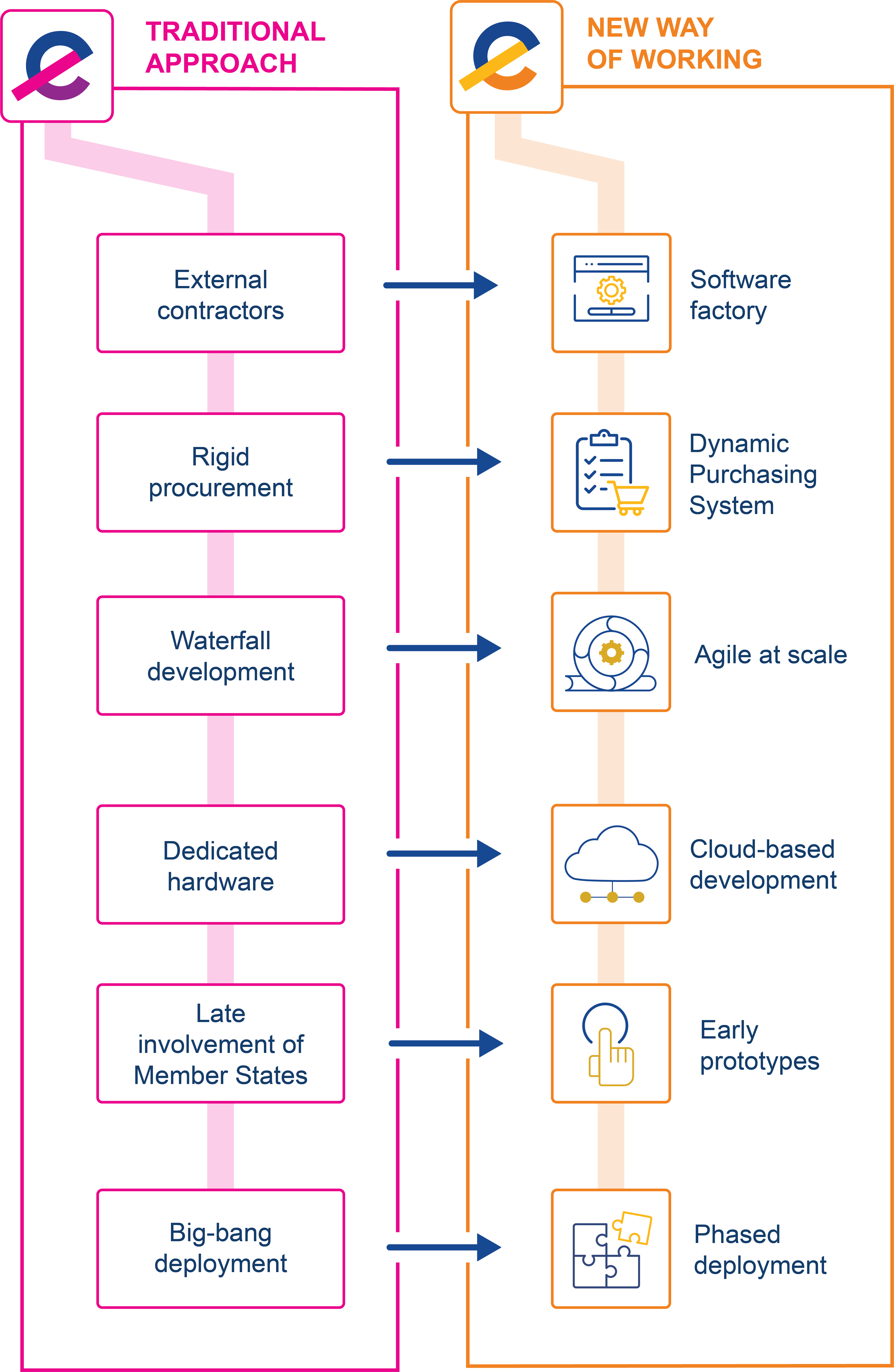
After successive delays experienced with EES, the Agency conducted an internal review in 2023 to understand why progress had stalled. Several root causes were identified:
- Over-reliance on external contractors, which limited the Agency’s control over the development of new systems.
- Rigid procurement rules, that slowed down delivery.
- A traditional waterfall development cycle (requirements → design → build → test → release).
- Lengthy hardware procurement needed for the development environments.
- Late involvement of Member States, only once the product was already stable.
- A big-bang approach where EES and all interoperability components were initially meant to go live simultaneously.
To address these weaknesses, the Agency has transformed its way of working (see fig. 2), a change first applied in Eurodac, through:
- In house expertise, replacing outsourcing with internal teams through the “Software Factory” approach, which ensures better control over the final product, accelerates development, and minimizes contractual constraints.
- Flexible procurement, using Dynamic Purchasing Systems to quickly engage specialised expertise, foster competition, and reduce procurement lead times, enabling the Agency to respond effectively to changing requirements.
- Agile delivery, using iterative development cycles with transversal teams to deliver faster, produce minimum viable products (MVPs), and embrace the principle “Fail fast to succeed”.
- Early prototypes, sharing initial versions with the Member States at an early stage to obtain timely feedback and adjust development accordingly.
- Cloud-native development, using cloud infrastructure to support the development of new systems. This accelerates time to market by removing the need for time consuming procurement of dedicated servers, and enables adaptable, resilient and scalable solutions.
- Phased entry into operation. For Eurodac the scope was divided in two releases: a web-interface release in June 2026 covering the obligations stemming from the implementation of the Pact on Migration and Asylum; a system-to-system release in December 2026, addressing the remaining requirements.
With this new approach, eu-LISA is well equipped to deliver the next generation of EU systems. Eurodac is not just another system going live, it is the first proof that eu-LISA’s new delivery model works.
In the coming years, the evolution of the border management landscape will see the entry into operation of several components: ETIAS, a prior authorisation system for visa exempt travellers; the revised VIS, extended to long term visas and residence permits; and the EU Visa Application Platform, which will enable online applications for Schengen visas, replacing the physical stickers. An API PNR central router will also be developed, replacing the current individual connections between airlines and Member States and centralising the exchange of Advance Passenger Information (API) and Passenger Name Record (PNR) data. Finally, the Digital Travel Authorisation (DTA), currently under adoption, will introduce digital travel credentials that travellers can store on their phones. Combined with pre clearance by border authorities, this will enable faster border checks and reduce waiting times. eu-LISA will develop the dedicated application.
The success of these systems relies on joint efforts across the entire ecosystem:
- Development and seamless operation of the central systems by eu-LISA.
- Adaptation of the national systems by the Member States.
- Redesign of processes and passengers flows by Member States and ports/airports operators.
- Provision of adequate capacity and training for border guards by Member States.
- Connection and use of the system by carriers according to their new obligations.
As Henry Ford once said, “Working together is success”. And working together is ultimately how these systems will succeed.