Actions
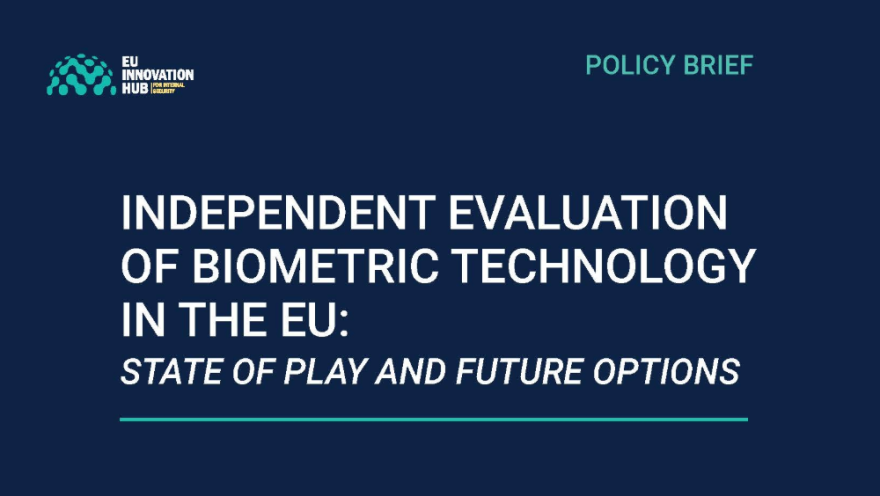
The EU Innovation Hub for Internal Security has published a new policy brief on the independent evaluation of biometric technologies in the European Union, highlighting the need to strengthen EU-level capabilities to ensure accuracy, transparency and trust in the use of such systems. The work was coordinated by eu-LISA.
Biometric technologies, including facial recognition and fingerprint systems, are increasingly used across critical domains such as border management, migration, law enforcement and digital identity. While these technologies bring clear benefits in terms of security and efficiency, their use also raises important questions related to fundamental rights, accuracy, bias and accountability.
The policy brief provides an overview of the current landscape in the independent evaluation of biometric technologies and identifies key challenges in the EU, where evaluation practices remain fragmented and largely dependent on external actors, notably non-EU organisations. This reliance hinders EU’s ability to independently assess performance, ensure compliance with its legal framework and address EU-specific operational needs.
The analysis highlights that independent, transparent and standardised evaluation is essential to:
- support public authorities in procuring reliable biometric systems,
- enable policymakers to develop evidence-based regulation,
- ensure compliance with EU data protection rules and the Artificial Intelligence Act, and
- strengthen public trust in the deployment of biometric technologies.
Key findings
The policy brief identifies several risks linked to the absence of a dedicated independent EU-level evaluation capability which can have a detrimental impact on EU’s technological sovereignty, including:
- lack of trusted and comparable performance benchmarks,
- fragmentation of evaluation approaches across Member States,
- limited transparency regarding bias and system vulnerabilities,
- slower and riskier deployment of biometric systems, and
- reduced EU influence in global standard-setting.
Proposed way forward
To address these challenges, the policy brief puts forward two complementary proposals to establish a sustainable EU-level evaluation capability:
- a common EU biometric data repository, built on legally compliant, secure and representative datasets reflecting EU operational contexts;
- a centralised biometric evaluation and testing platform, enabling standardised, independent and continuous assessment of biometric technologies, including benchmarking across vendors.
These initiatives would be supported by secure infrastructure and implemented by a trusted public authority, ensuring full alignment with EU data protection rules.
Strengthening Europe’s digital sovereignty
By developing its own independent evaluation capacity, the EU would reduce its reliance on external actors, strengthen regulatory oversight and reinforce its position as a global leader in trustworthy and human-centric digital technologies.
The policy brief contributes to ongoing EU efforts to ensure that technological innovation goes hand in hand with fundamental rights protection, transparency and accountability, while supporting the effective functioning of large-scale IT systems in the area of freedom, security and justice.
Background
The policy brief was developed by the Biometrics Cluster of the EU Innovation Hub for Internal Security, coordinated by eu-LISA, in cooperation with the European Commission (DG HOME and DG JRC), Europol and Frontex.